
B-King – Suzuki’s Thrill Ride. We ride and race and review the biggest baddest naked bike on the planet.
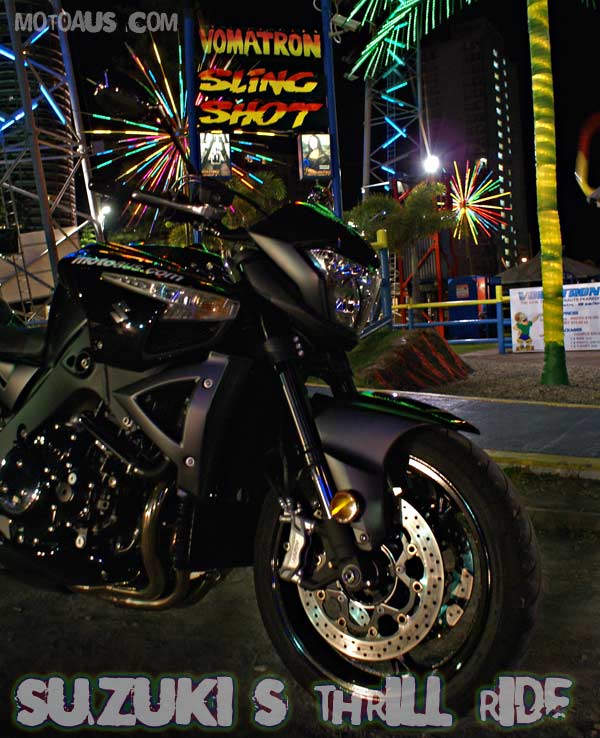
Suzuki B-King
I think it was when the fourth person who said.”What the **** is that?!” that I felt the deja vu. From the early 80’s. As a proud new owner of Suzuki’s now iconic Katana 1100, I had withstood the barrage of both scorn and admiration from those who first laid eyes on that silver beast. More than 25 years later, I was hearing it again, this time with another radical monster from Suzuki. The 1340cc B-King.
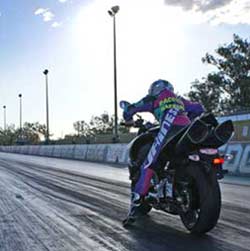 After a brief stint with a silver and black B-King when they were first released, we were getting used to being the centre of attention again. This time it was for more reasons than its appearance. After a series of low 10 second drag-strip efforts by various motorcycle magazines on the K8 Hayabusa, we were anxious to see how the reportedly less powerful B-King would fare at the drag-strip.
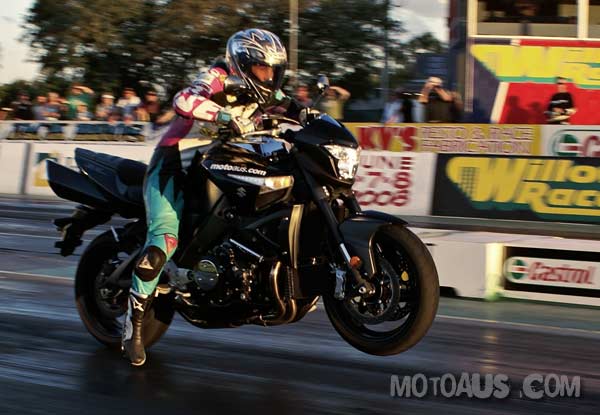
Any question marks about its performance pedigree were washed away as Motoaus’ Rebecca belted out a nine second run down Willowbank’s drag-strip on the totally showroom stock Suzuki B-King.
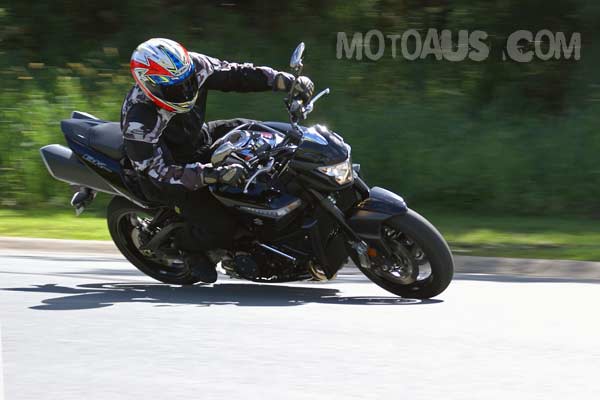
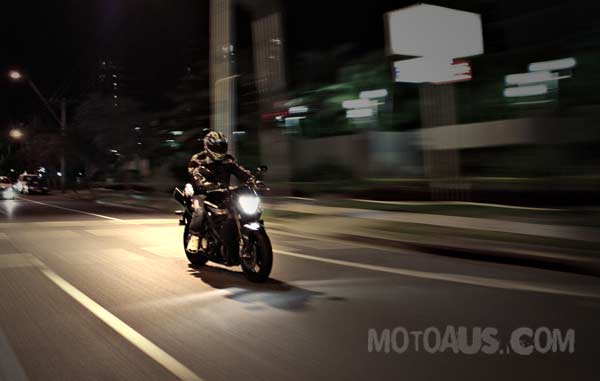
With no modifications or adjustments, the big black B-King could have been ridden away from the track for an easy commute, a blast through winding roads, or even a long distance run. It is without doubt one of the most versatile motorcycles I have had the pleasure of riding. And ride it we did. Freeway traffic, damp mountain passes, beach-side cruising. The massive wide tank section with its bolt on extensions appears to shrink as you sit on it. Underway it shrinks again, the bike feeling small compared to its faired Hayabusa brother. Those corners seemed to appear much sooner than on lesser powered machines.
Riding the B-King
Despite adding wheelbase length over the Busa, the B-King’s higher bars, and balanced feel practically beg you to throw it into the next corner. The B-King’s turbine smooth power delivery and near perfect fueling deliver a corner to corner rush unrivaled in the motorcycle world. Consider these stats taken from the drag strip run. Zero to 185 km/h in 200 metres. From a standstill. And even with a lack of streamlining, the brute powered on to just under 230km/h in the next 200 meters. Equating the 1340cc motor lifted from the new K8 Hayabusa to a turbine is about as close as you can get to describing it.
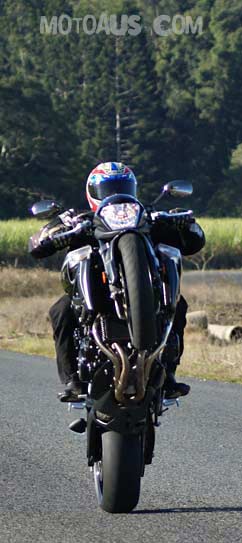 The absence of an induction roar, coupled with a very quiet exhaust note gives the B-King a silky smooth howl all the way up to red line. No harshness, no flat spots, just an eyeball flattening rush. Equally impressive is the lack of wind turbulence that accompanies this rush of speed. Sure, you wont be opening an umbrella under power, but the wind blast only becomes a factor well in excess of legal speed limits, and even then it isn’t a harsh buffeting, just an increase in wind speed. I’m guessing the headlight cowl and huge tank mounted side pods play a far larger part in the aero than you would think.
The B-King chassis retains the overall layout of its Hayabusa brother, but is in fact an entirely different chassis. The swing arm sports not only an increase in length over the Busa, but to allow the underseat exhaust to pass, the shock is mounted off centre to the left hand side of the bike. Up front, trail is out to 107 mm – 14mm over the Hayabusa – and rake is about a degree less steep. The B-King has KYB forks and four piston Nissin calipers, again different to the Busa’s Tokico 4 potters.
Despite the massive difference in ergonomics when sitting on the two related big Suzuki’s, seat height is identical at 805mm. The higher positioned bars give more leverage, more than compensating for the increased rake/ and rail which has no doubt been added for extra stability at high speed. In the B-Kings case, limited speed. Suzuki claim the bike to be limited to 168mph (270km/h), and is probably a wise idea given its lack of screen, meaning the bike will most likely be as fast in 5th gear as top.
Suzuki quote less horsepower for the B-King than the Hayabusa, however despite no official confirmation, it would appear to be related only to exhaust, air intake and tuning, as the hard parts used inside the 1340cc lump are identical in specification, from compression, to cam lift. Titanium valves and injector bodies are identical as well. The ‘ram air” advertised for the B-King appears to be less effective than the fairing mounted scoops of the Hayabusa with the B’s huge side pods little more than hollow shells that direct air through holes in the main frame rails to the air box. Specifications are one thing however, real world is another. The B-King feels faster everywhere, it never shook its head in any kind of situation, and most feats are easier attempted on the B-King over the supposedly faster Big Brother Busa, including wheelies and stoppies.
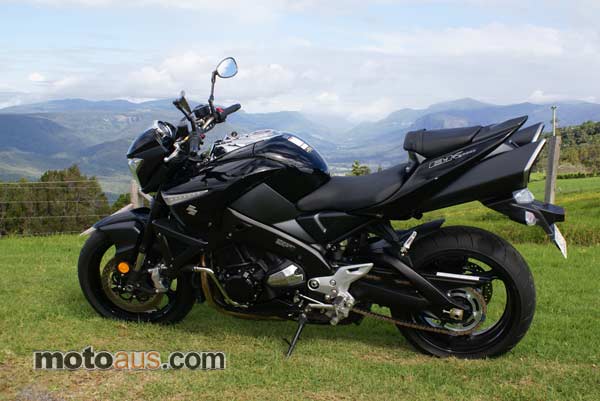
Most amazing of all is how nimble such a big, long and heavy bike can be. Sporting a porky 230 plus kg of claimed dry weight, the only time you might really notice this is hard under brakes, particularly downhill. Hairpin corners, and flip flopping from left to right feels no more difficult than much smaller bikes.
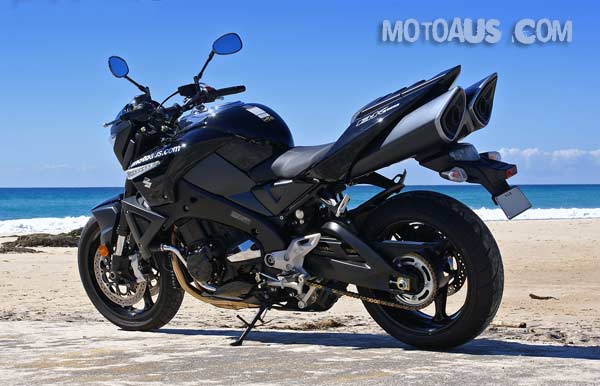
Pillion passengers aren’t really catered well for with a narrow, high mounted seat similar to that found on a super-sports bike. Most B-Kingers will be seen with the plastic tail piece in place you would think. The relatively small 16.5 litre fuel tank didn’t provide us with any problems, perhaps due to our style of riding and refueling, but despite fairly heavy application of the throttle, we put over 200kms on one tank without running out.
When we put a couple of hundred kilometers at a time in on the B, there were no complaints of any soreness, or seat issues. Serious long distances would probably be improved by a small screen, and one is available from Suzuki as an accessory .
At the Drag-strip
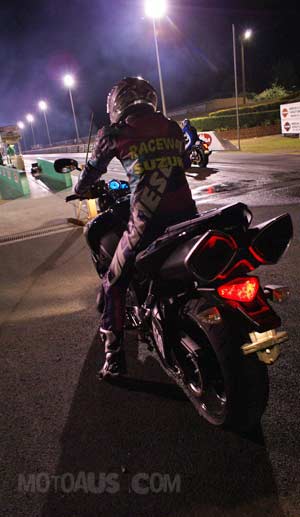 After a series of articles on what it takes to get a street bike into the nine second zone, Motoaus had managed to get a lowered 2000 model Hayabusa to a best of 9.61 seconds down the quarter. With more horsepower and wheelbase, we were keen to see how the B-King would fare at the strip.This time however, we wanted to try the bike in its dead standard form, exactly as it came from the crate. Complete with half a tank of unleaded, we had Rebecca enter one of the popular bike “Shootouts” at Willowbank Raceway.
A couple of things soon became apparent. The B-King was in fact a little down in outright top end speed over the quarter, most likely a combination of its heavier weight, less efficient ram air, lower horsepower and perhaps an aero factor less than the Hayabusa. The other was, despite its 1525mm wheelbase, it was difficult to launch hard. Two things conspire against you here, mainly the back torque limiter in the clutch acting as a lockup device under hard launching, making clutch control difficult, and the 10 plus kilos of muffler and brackets hanging high in the rear tail making for a wheelie inducing ballast.
Neither issues are difficult to fix for anyone with a bent for drag racing. The BTL in the clutch can be replaced with a locked unit for more controllable clutch action, and the muffler assembly is easily replaced with a multitude of aftermarket lighter units. However the above is in regard to serious attempts at quarter mile work, casual strip punters will find the bike easy to ride and launch at less than full-on attempts.
The first few runs on the bike with the sub 60kg suited Rebecca had produced a best of 10.04 seconds at around the 140 mph mark, with most hard launching runs ruined with a time killing wheelie. After some head scratching there wasn’t much to try, we just added a little pressure to the rear tyre to stop it hooking up so hard.
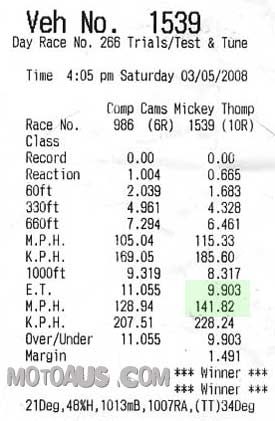 Despite the temptation to lower the bike, or change the pipes, the idea was to see what the thing would do stock, gearing, mirrors, factory tyres, pump fuel and all. Several more attempts ended again with wheelies, before Bec finally nailed a good run, a 9.903 at just over 141 mph. Several more 9.9s were run, but she couldnt manage to put together anything better to squeak it into the 9.8 second zone, however we left with the feeling of mission accomplished. Rebecca reported no stability or wind blast issues at over 140mph (225km/h) top end speeds.
While Bec’s time maybe hard to reproduce for the average man sized rider, its worth noting that I placed my own 90kg plus bulk onto the B-KIng for a run to see what would happen. My first attempt resulted in an immediate wheelie from the unexpected clutch lock. A more sensible approach on the second run resulted in a smoother launch and a 10.43 second pass.
Between 10.0 and 10.5 is the kind of ET that most would be seeing at a dragstrip, and that can be achieved with not much more than a fast traffic light style leave, and getting as much throttle on as early as possible. With standard gearing, the B-King almost makes it through the full quarter mile in 3rd, requiring a shift to fourth at around 130mph.(210km/h)
Odds and Ends
The oft commented on “huge” petrol tank, is actually a standard sized and shaped tank, with bolt on plastic scoops each side covering the frame, and serving as an effective wind deflection device, a housing for the front flashers, and the inlet path for fresh engine air.
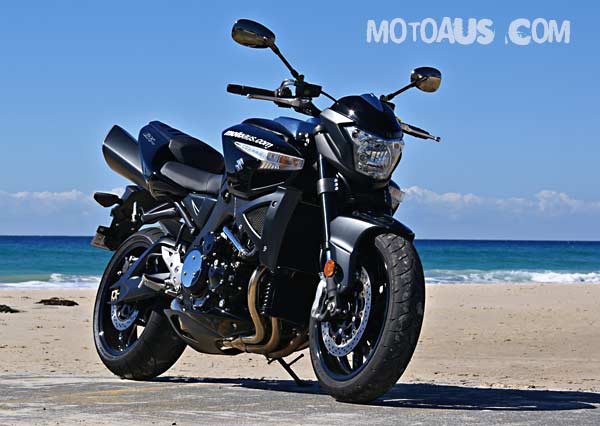
Mounted on the tank is the S-DMS drive mode selector, offering a full power” A “mode, and a “B” mode that feels like its about 30% down on power, like a party with no music. I chose to leave it in A mode at all times, including in the wet, others might find some benefit if pushing hard on a wet road to do away with a few horses. The mode wasn’t selectable on the fly, requiring a neutral gear position and a stopped bike to be switched.
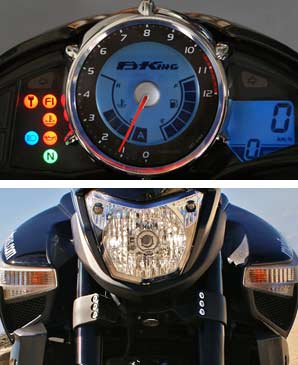 The other tank mounted button controls the Instrument functions, average speed, two trip meters, clock, maintenance interval, and running time. The dash also features a fuel gauge, gear position indicator, and temp gauge, but no shift light unfortunately. The large centrally mounted tacho was easily readable, but the digital speedo read out, positioned off to the right, was a little hard to see at times with reflections on the glass.
Between the two buttons is the ignition switch, which also incorporates the steering lock. Forward of the tank is a frame mounted steering damper which is not adjustable.
The front seat is removed by a lock on the side panel, and then a cable release allows removal and interchange between pillion seat, or a plastic solo seat cover. Meaningful storage is non existent under-seat due to the muffler location, the tool kit has its own container under a removable side cover.
The standard Dunlop qualifiers worked perfectly, however the reasonably hard throttle applicators among you will be replacing them fairly regularly. The traction was excellent at the dragstrip, and in all weather road carving. They did get fairly hot and soft, which would result in fast wear if using a heavy right hand exiting corners.
Summary
If you can’t tell yet, we loved it.
Everyone who rode it did too. You probably will as well if you ride or buy one. Some will not be able to overcome their desire for sameness to like the look of the B-King, fair enough. Beauty being in the eye of the beholder, this beholder loved its brutal angular form. Only a Suzuki salesman would call it pretty, but who wants a 230+ kg, near on 200hp, 1340cc bike to be pretty?
I’ll take mine mean, ugly and fast. They don’t come much meaner, or faster than the B-King. 9 seconds at the drag-strip, power wheelies off the throttle in any of the lower gears, combined with deceivingly good handling and powerful predicable brakes, what more could you ask for? Perhaps a little less weight, and better pillion provision, but Suzuki have come close to making a flawless bike for the market it is intended for.
Ins and Outs
Great:
Huge power with a lashing of smooth.
Surprisingly good handling for its size.
Stand out in the Crowd styling.
Fit and finish is first class.
Not so Great:
Pillion seat on the small side.
Fuel range could be better
No shift light – on a bike destined for greatness on the drag-strip.
You may not appreciate the styling.
Suzuki B-King Specifications
Dimensions
| Overall length |
2245 mm (88.4 in) |
| Overall width |
800 mm (31.5 in) |
| Overall height |
1085 mm (42.7 in) |
| Wheelbase | 1525 mm (60.0 in) |
| Ground clearance | 120 mm (4.7 in) |
| Seat height |
805 mm (31.7 in) |
| Dry mass | 235 kg (518 lbs) |
Engine Specification
| Type | 4 cyl, 4-stroke, Liquid-cooled, DOHC |
| Bore | 81.0 mm (3.189 in) |
| Stroke | 65.0 mm (2.559 in) |
| Displacement | 1340 cm3 (81.8 cu. in) |
| Compression ratio | 12.5 : 1 |
| Fuel system | Electronic Fuel injection system |
| Lubrication | Wet Sump |
| Clutch | Wet multi-plate type |
| Transmission | 6 speed constant mesh |
| Primary reduction ratio | 1.596 (83/52) |
| Gear ratios | |
| 1st | 2.615 (34/13) |
| 2nd | 1.937 (31/16) |
| 3rd | 1.526 (29/19) |
| 4th | 1.285 (27/21) |
| 5th | 1.136 (25/22) |
| 6th | 1.043 (24/23) |
| Final reduction ratio |
2.388 (43/18) |
| Drive chain | RK GB50GSV Z4, 118 links |
Chassis Specification
| Front suspension | Inverted telescopic, coil spring, oil damped |
| Rear suspension | Link type, coil spring, oil damped |
| Front suspension travel |
120 mm (4.7 in) |
| Rear suspension travel | 137 mm (5.4 in) |
| Caster | 25d 30’ |
| Trail | 107 mm (4.21 in) |
| Turning radius | 3.0 m (9.8 ft) |
| Front brake | Twin 310mm disc |
| Rear Brake |
Single 260mm disc |
| Front Tyre |
120/70ZR17M/C (58W), tubeless |
| Rear Tyre |
200/50ZR17M/C (75W), tubeless |
Links
Suzuki B-King Wide Screen Wallpaper
B-King night DragStrip Wallpaper